

From Jeremi Karnell · November 2026
What’s New at ValuationMCP: A Tour of the Site
What's new on valuationmcp.ai, from the Solutions pages to public benchmarks for every size of RIA in every state.
Jeremi Karnell · 4 Nov 2026
For most of October, the menu on valuationmcp.ai didn't go anywhere. Click How it works and the homepage scrolled down to its How it works section. Click FAQ while you were on the FAQ page and it sent you back to the homepage, to read the FAQ you were already reading.
Everyone got the same long homepage, whether they owned one practice or ran a network of them. That's fixed. Each audience has a page of its own now, and every link in the menu goes somewhere.
ValuationMCP runs inside the AI assistant you already use, like Claude or ChatGPT. It connects through MCP, the open standard that lets an assistant work with other software. You ask what your practice is worth, your assistant reads your CRM and your books, and ValuationMCP gets only the totals, each with where it came from. What comes back is a valuation built seven different ways, with a range.
The animation below is live from the homepage, running on a made-up firm called Alder Ridge Advisors. Hit Replay to watch it again. There are a few more live pieces of the site further down, so click around.
Solutions
The Solutions menu has three entries.
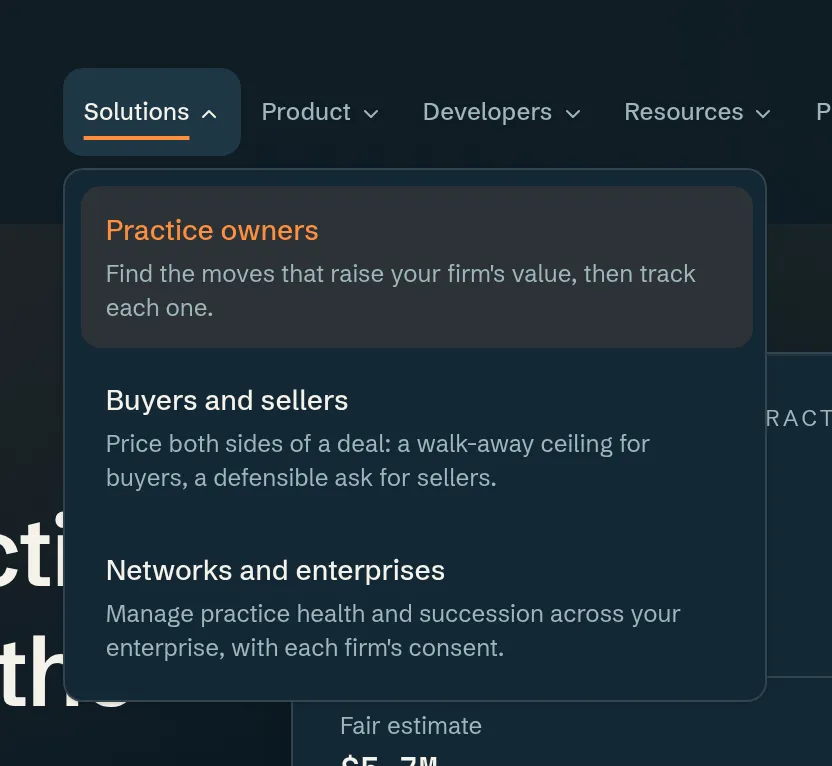
On Practice owners you get your number, with a range and a score for how solid the data behind it is, then the moves that would raise it, each priced in dollars. You can track those moves until a later valuation confirms them. The first full valuation is free.
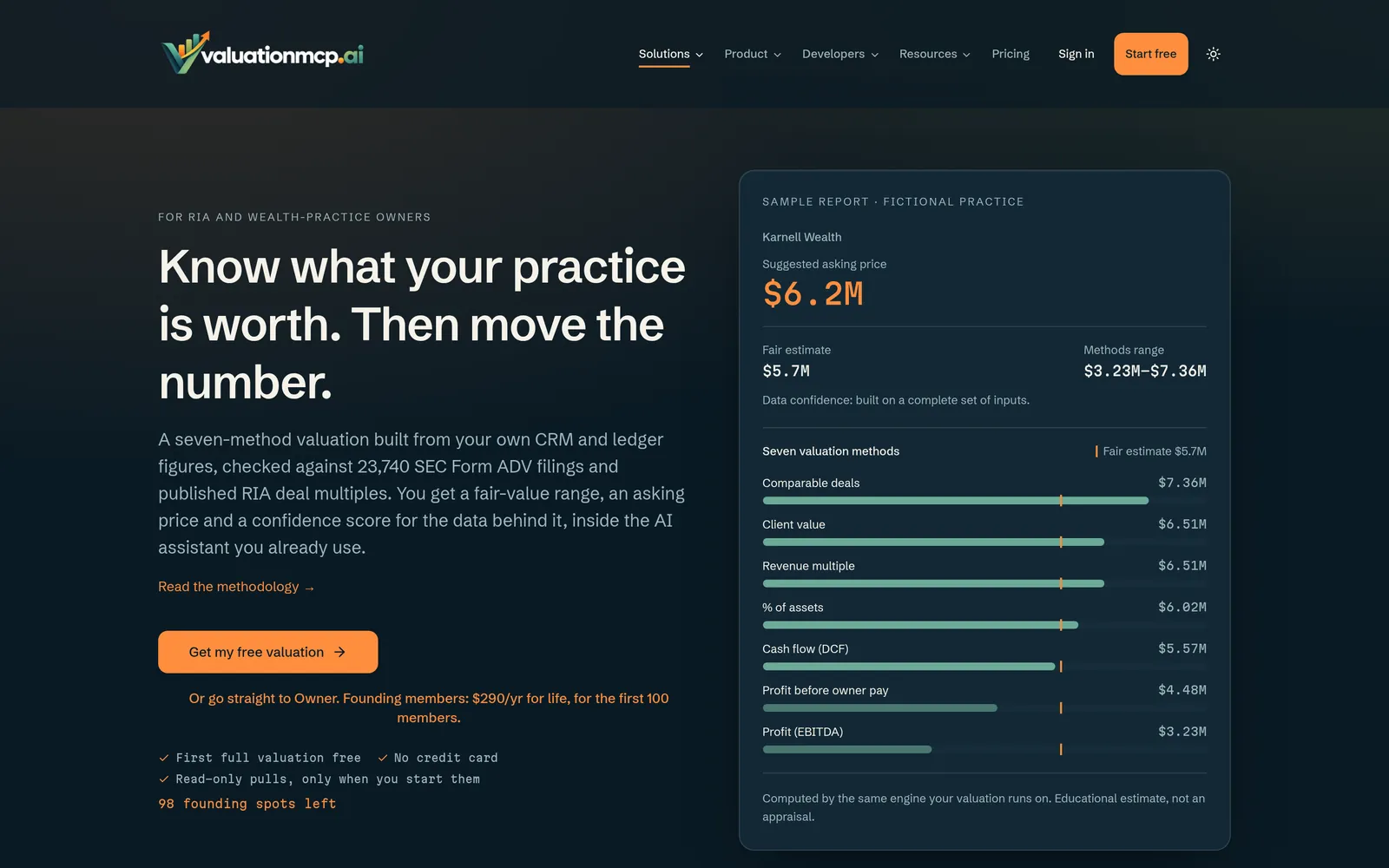
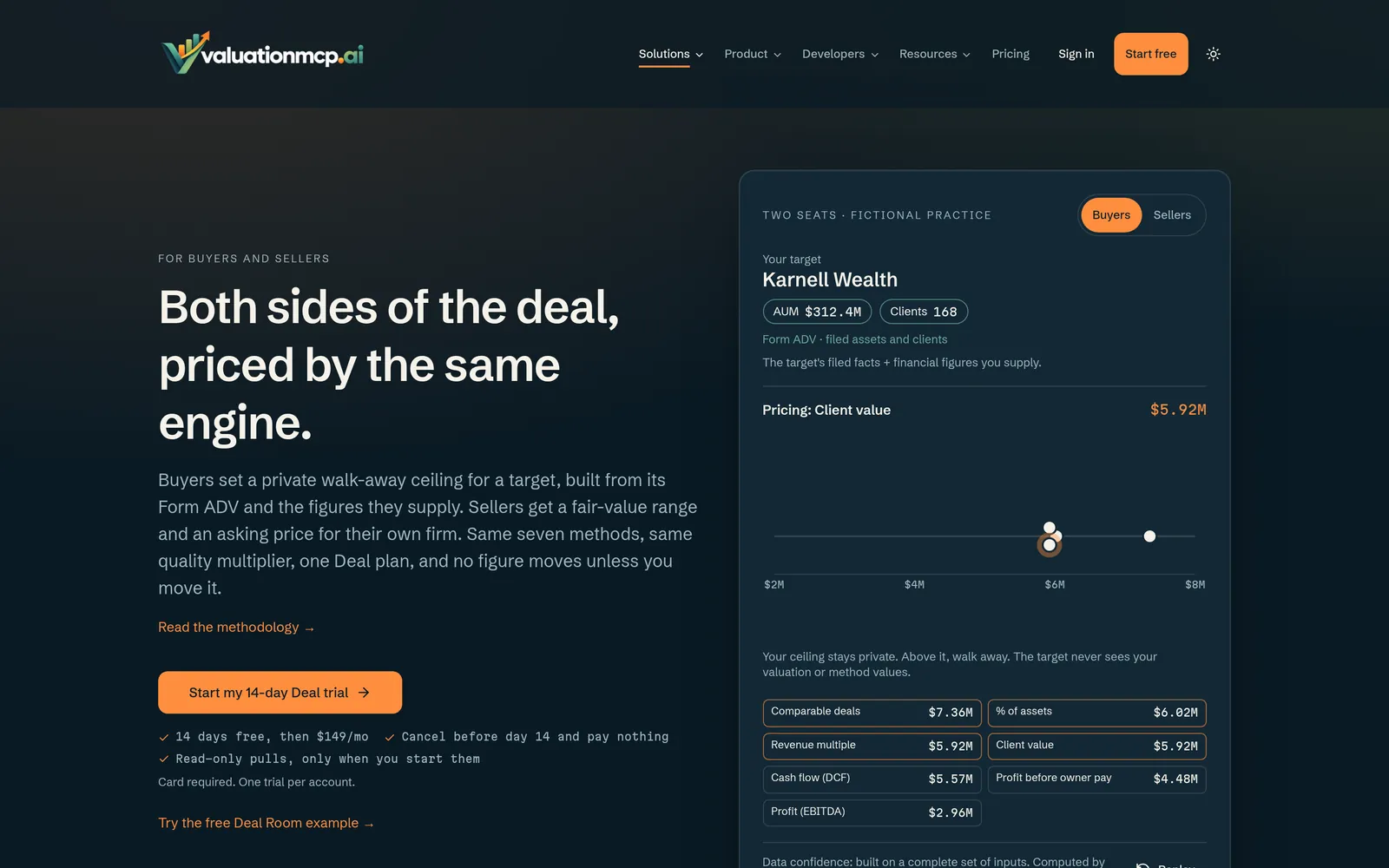
Buyers and sellers is one page now, since both sides are pricing the same deal. A buyer enters a target's CRD number, the ID every adviser has in the SEC's system, and its Form ADV fills in the assets and client count. The target's stated fees, retirement-plan filings and 13F holdings show up too, as evidence to check claims against, but none of them feed the valuation. A seller runs the same seven methods on their own firm. A buyer's ceiling can't be shared at all, and a seller picks which figures the other side sees.
The third entry, Networks and enterprises, is for broker-dealers, aggregators and advisor networks. With each firm's consent, a network can see value and succession across its practices in one place. ValuationMCP introduced that view this week as Network Insights.
Below is the succession view on a made-up broker-dealer. Each dot is a practice, placed by when its owner plans to retire and how ready a successor is. Click one to see its valuation and the nearest buyers inside the network.
Before you connect anything
If you'd rather see what's under the hood first, How it works, Methodology and Trust & data use cover it.
Your assistant does the reading and the engine does the math. There's no AI in the arithmetic, so the same inputs always give the same number. Methodology shows all seven methods with their formulas, plus the quality score that can push two of them up or down.
Move the number
Every saved valuation comes back with whatever is holding it down, and the engine prices each fix by re-running your valuation with only that one thing changed. You can assign a move to yourself, to someone on your team or to the ValuationMCP Agent, and your next valuation checks whether it really happened. Move the number walks through the whole loop.
Here's one made-up firm's list.
Deal room
The Deal room works from either side of the table now. Sellers rehearse the buyer's pushback and buyers test the seller's story, each in private. When it's time to talk, either side can open a room and choose what the other side sees. The AI writes the arguments but never the numbers, which come from the saved valuation or a public filing.
There's a free example on the page you can run on any firm that files a Form ADV.

Benchmarks
Benchmarks is the biggest addition. Every SEC-registered RIA files a Form ADV listing its assets, clients and staff, and advMCP serves those filings to AI assistants. The Benchmarks pages turn them into something an owner can use: 312 pages covering every size of firm, nationally and in every state.
Take Texas firms with $100M to $250M under management. There are 211 on file, with a median of $167.1M. The Sica Fletcher SCF Index puts practices that size at 0.9% to 1.3% of AUM, which would value the median firm at $1.50M to $2.17M. That's one method out of seven. The other six need revenue and profit, which Form ADV doesn't carry, and that's where your own valuation comes in.
Pick a size and a state.

Every number on those pages has a source and a date. If a state has fewer than 10 firms in a size band, its page shows the count and nothing else. And the multiples are published ranges for firms of a given size, not actual deal comps. Private transaction data is the hard part, and it isn't in there yet.
Market notes
This post lives in Market notes, which is also new. Once a month there's a short note on RIA deals and published multiples, with every number sourced. The first one looks at three Q3 deal counts that don't agree (125, 77 and 60) and what each tracker is counting. My LinkedIn articles are collected there too.
For developers
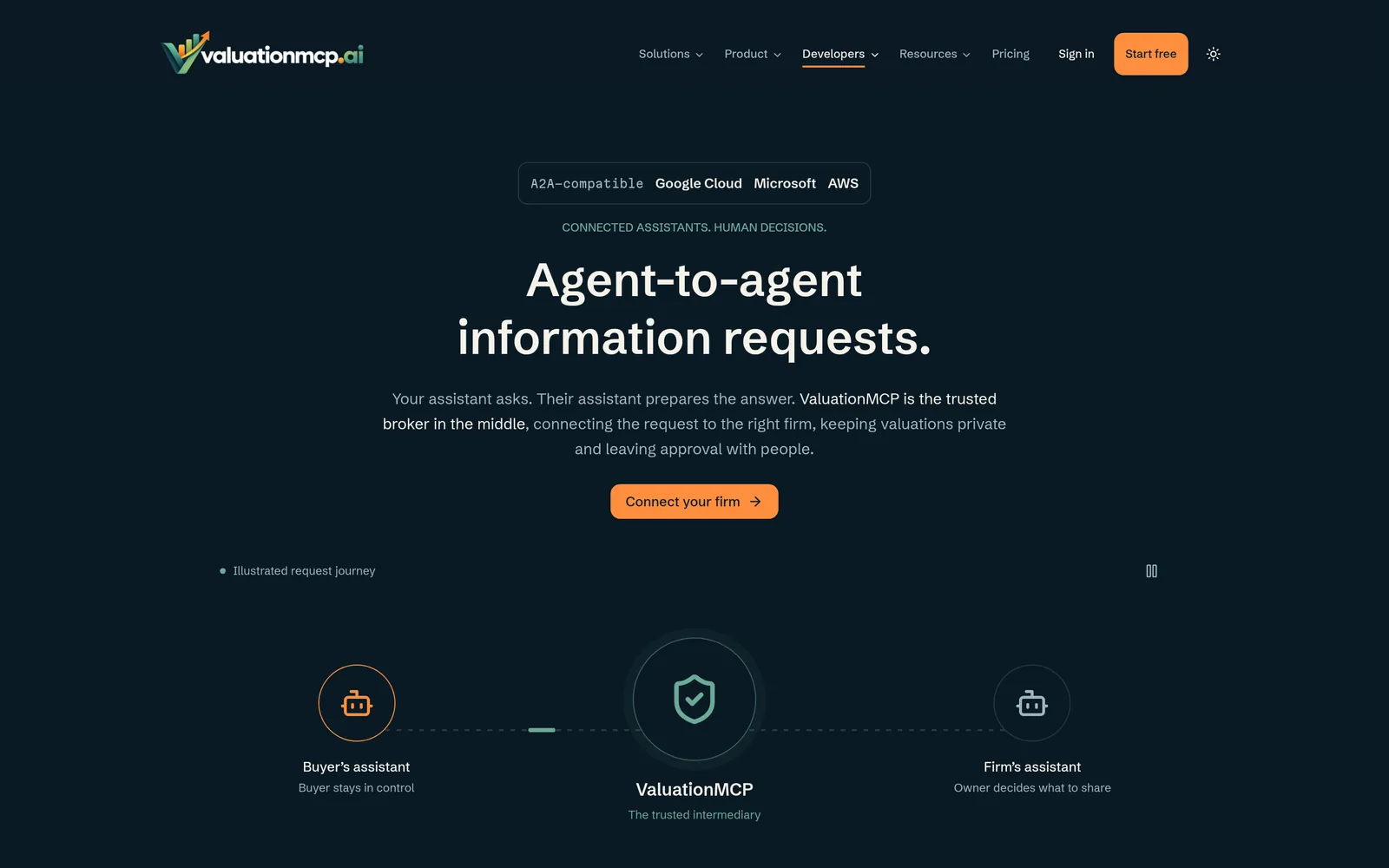
Developers get a reference for the 18 tools the MCP server exposes, and a page on agent to agent requests. A2A is the open protocol that lets one company's AI agent send a structured request to another's. With ValuationMCP brokering, a buyer's assistant can ask a target's assistant for figures under NDA, and a person approves every step.
Pricing
Pricing has four plans. Free gets you the whole workbench and one recorded valuation. Owner is $39 a month, or $390 a year, for your own firm, and the first 100 members can lock in $290 a year for life. Deal covers buyers and sellers at $149 a month, or $1,490 a year, and starts with a 14-day trial. Network is priced by how many advisors you have, not by seats.
Where to start
If you own a practice, run your first valuation. It's free. If you're on either side of a deal, try Deal for 14 days. If you run a network, ask for a demo. And if you just want to see where firms like yours sit, Benchmarks doesn't need an account.
One group still doesn't have a page: the consultants, CPAs, attorneys and lenders who work alongside these deals. If that's you, tell me how you'd want to use it.
And yes, the FAQ link goes to the FAQ now.
Market commentary from public sources, quoted as each publisher released it. Not investment, legal or tax advice, and not an appraisal of any firm.